
Knowledge Hub

Traceability: Toward the International Standardization of Requirements
Introduction
The reprocessing of ultrasound probes has become a major public health issue in a context marked by the increasing incidence of healthcare-associated infections (HAIs) and the emergence of resistant pathogens such as Candidaauris, staphylococci, and certain viruses, including human papillomavirus (HPV).
Beyond the effectiveness of disinfection processes, health authorities now require the ability to demonstrate compliance with recommended practices. This evolution reflects a structural shift: patient safety now relies as much on the quality of reprocessing procedures as on their traceability. Traceability has therefore become a central component of infection control, audit processes, and risk management systems.
Traceability as a Pillar of Patient Safety
Traceability refers to the ability to retrieve the history, use, and pathway of a medical device throughout its life cycle. In the case of ultrasound probes, traceability consists of reliably linking the patient, the device, and the reprocessing steps, particularly the disinfection process. This requires the systematic recording of essential information related to patients, operators, performed procedures, and reprocessing parameters.
.png)
Traceability fulfills two essential functions.
- First, it supports operational risk management by enabling the rapid identification of potentially exposed patients in the event of an incident.
- Second, it enables the demonstration of compliance by providing auditable evidence during inspections, audits, or accreditation processes.
Within this framework, traceability is no longer merely a tracking tool but a structural element of quality and safety in clinical practice.
Operational Constraints Driving Change
The evolution of regulatory requirements highlights the limitations of traditional traceability systems. Manual processes remain common but are inherently vulnerable in terms of data reliability, completeness, and availability.
In constrained hospital environments, operational workload, variability in practices, and the need to produce immediately usable data during audits further exacerbate these limitations. In addition, ecological considerations, data security requirements, and resource optimization challenges are accelerating the shift toward more structured and digitalized traceability approaches.
International Convergence of Regulatory Requirements
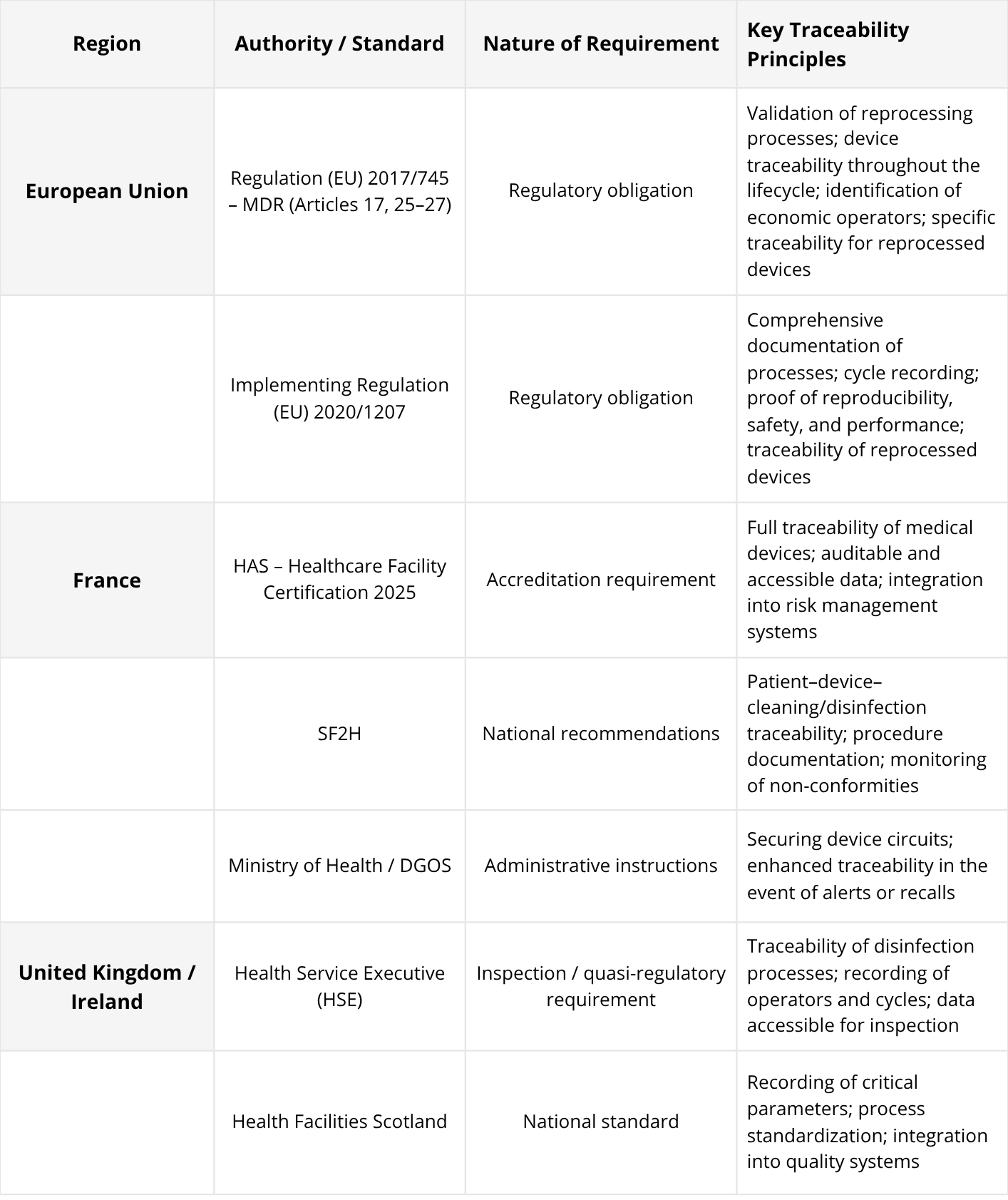
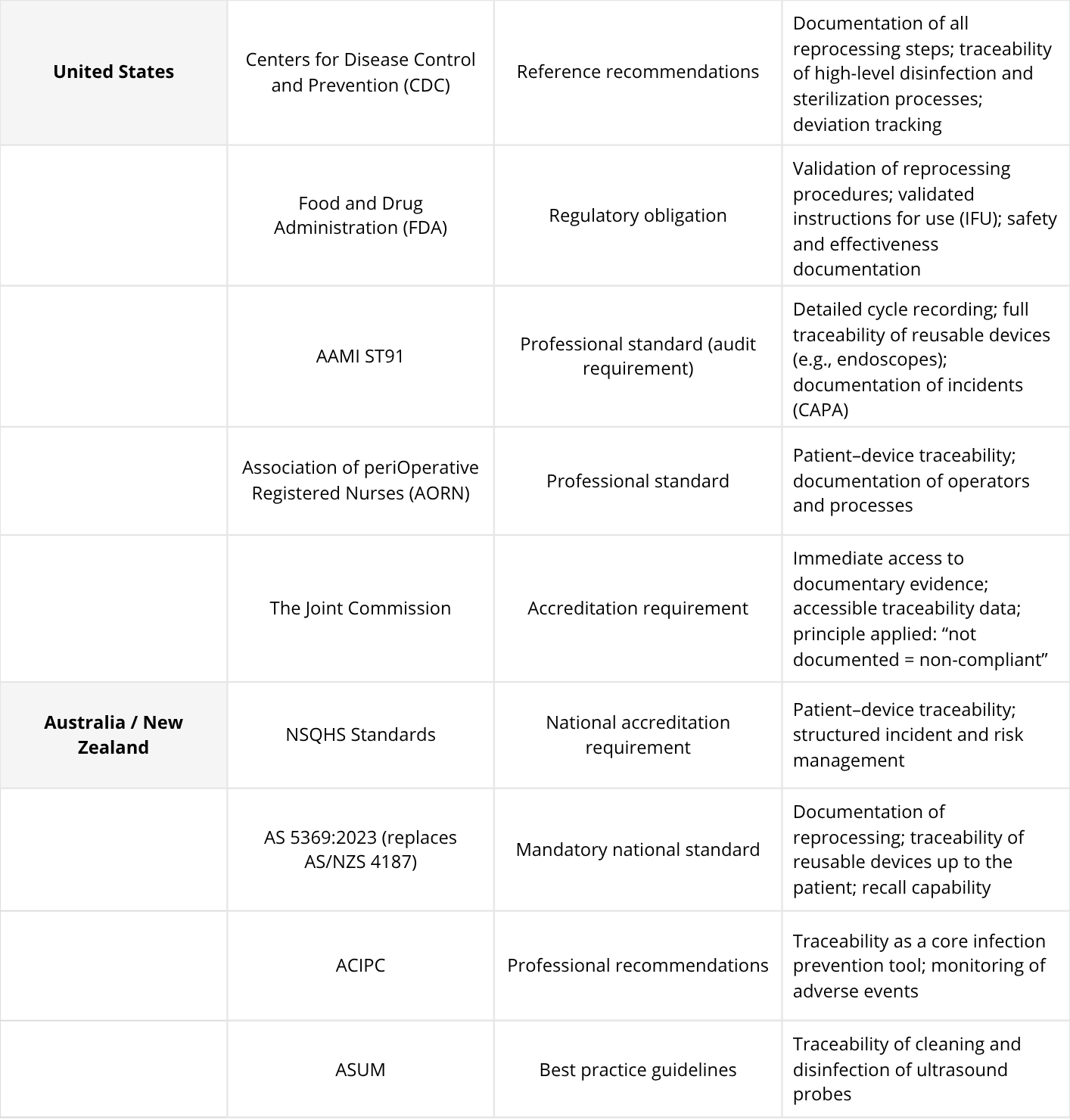
Despite national regulatory differences, a clear convergence is emerging around common principles: systematic linkage between patient, probe, and disinfection cycle; comprehensive documentation of reprocessing procedures; and traceability of incidents and non-conformities.
This convergence reflects a major evolution: traceability is now considered a prerequisite for disinfection processes to be deemed compliant. The ability to rapidly access reliable traceability data is now embedded in most international standards and regulatory frameworks.
Regulatory Landscape by Geographic Area
Digitalization as a Lever for Standardization
The analysis of regulatory frameworks reveals a common limitation oftraditional systems: their reliance on manual processes and their inability to guarantee immediate data availability.
In this context, the digitalization of traceability is increasingly recognized as a structural response. Digital solutions enhance data security, reduce practice variability, and facilitate audits by ensuring rapid and reliable access to information.
Conclusion
The traceability of ultrasound probes is now emerging as a structured international standard. It is no longer limited to a documentary requirement but has become a key component of patient safety and regulatory compliance.
Across regulatory frameworks, a clear convergence is evident: the ability to trace, document, and retrieve information has become inseparable from the quality of clinical practice. In this context, digitalization represents a critical lever for sustainably strengthening control over infection-related risks.
Sources :
- https://www.sf2h.net/
- https://sante.gouv.fr/
- Health Technical Memorandum 01-06: Decontamination of flexible endoscopesPart C: Operational management
- https://scanforsafety.nhs.scot/
- https://www.cdc.gov/infection-control/about/index.html
- https://aami.org/
- https://www.aorn.org/
- https://www.fda.gov/
- Reprocessingof reusable medical devices in health service organisations (2014): StandardsAustralia and Standards New Zealand AS NZS 4187 2014
- Guidelinesfor Reprocessing Ultrasound Transducers (2017) : Australasian College forInfection Prevention and Control (ACIPC), Australasian Society for Ultrasoundin Medicine (ASUM)


Subscribe to our newsletter for:
Company and Product updates


Clinical and Scientific Knowledge
Latest News